If you're looking for something for your car, sooner or later you come across two terms: vinyl wrap and PPF. Both are adhesive films that go on top of the paint, which is why people mix them up. But they do different jobs: vinyl is for changing the look of the car, and PPF is for protecting the paint without changing it. We sell vinyl, not PPF, but here we explain the differences honestly, including where PPF comes out on top.
What is PPF?
PPF stands for paint protection film. It's a clear film, thicker than a coloured vinyl, designed to take the stone chips, scratches and everyday marks instead of the paint. Once fitted, you can barely see it: the car keeps its usual colour.
It's mostly used on the areas that suffer most: the front end, bonnet, wing mirrors, front wings, door sills and the boot loading lip. Many PPFs have a top coat that makes fine scratches disappear with heat. There are also matte PPFs, which change the sheen of the paint without changing its colour.
What is vinyl wrap?
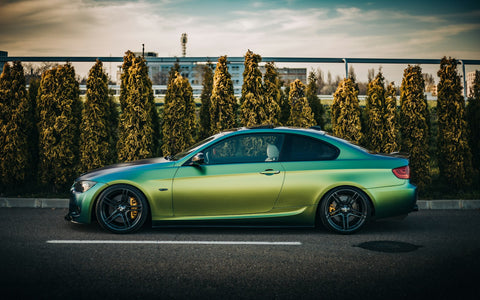
Car wrap vinyl is a coloured or effect film that covers the paint and gives it a new look: a different colour, a matte finish, chrome, carbon fibre or a colour-shift effect. You can wrap the whole car or just part of it, such as the roof or the wing mirrors. And along the way, it protects the paint underneath from fine scratches, the sun and stone chips.
Our vinyl comes in rolls 152 cm wide, with air-release channels, repositionable and heat-formable, so you can fit it at home with some patience and a few basic tools.
Quick comparison
| Vinyl wrap | PPF | |
|---|---|---|
| What it's for | Changing the colour or finish | Protecting the paint |
| Look | Hundreds of colours and effects | Clear (gloss or matte) |
| Protection | Fine scratches, sun and stone chips | Better against stone chips and scratches |
| Price | From €14.99 for the material | Usually a good deal more |
| DIY | Yes, starting with easy parts | Hard; almost always done by a pro |
| Removable | Yes, with heat | Yes, with heat |
Where PPF wins
- If you love your colour: if you don't want to change anything about how the car looks and just want to keep it perfect, PPF is for you.
- If you do a lot of motorway miles: the front end takes a lot of stone chips, and PPF is made for exactly that.
- On new or high-end cars: many people fit it as soon as they buy the car, to protect the front end from day one.
Where vinyl wins
- If you want a change: PPF doesn't change the colour. If you want a black roof, a chrome delete or a whole car in a new shade, you need vinyl.
- Price: a gloss black roof costs €69.99 in vinyl. With PPF the look doesn't change and you pay a good deal more.
- Doing it yourself: coloured vinyl is more forgiving of small mistakes. PPF is clear: every speck of dust or crease shows, which is why it's almost always fitted by a professional.
- Special finishes: matte, satin, chrome, carbon fibre or the exclusive ICR® Premium colours are only possible with vinyl (or with paint, which costs far more).
You can combine them
You don't have to choose one or the other. A common combination is to wrap the car, or part of it, and protect only the front end with PPF, as that's what takes the most punishment. Another is to keep the bodywork under PPF and wrap the details: roof, wing mirrors, chrome delete or an interior in gloss black Premium carbon fibre. If you want PPF over vinyl on any area, check with the installer first.
For headlights, we have the clear headlight protection film: it protects the lens from stone chips without changing its colour or its light.
Three questions to help you decide
- Do you want the car to look different? If the answer is yes, vinyl. PPF doesn't change the colour.
- Are you going to fit it yourself? If you want to do it at home, coloured vinyl is much easier.
- What worries you more, the look or stone chips? If it's stone chips on the front end, PPF is the more specific answer.
So which should I choose?
PPF if you like the car just as it is and want maximum protection for the paint, especially on the front end. Vinyl if you want to change the colour or style, you're after a special finish, you want to do it yourself or you're on a tight budget. And if you want both, combine them.
If you go for vinyl, start with a full car wrap or with a small part, and keep a DIY car wrap kit to hand, with the Plus squeegee and the craft knife. If you're torn between vinyl and paint, we compare them in vinyl wrap or paint: which is better?
Frequently asked questions
Does a coloured vinyl wrap protect the paint?
Yes, from fine scratches, the sun and stone chips. It protects less than PPF against heavy impacts, but if a panel gets marked, you only replace the vinyl on that panel.
Do you sell PPF?
No. We sell coloured and effect vinyl, tools, window and headlight tint, and paint for wheels and brake calipers. For headlights, though, we do have a clear film that protects them from stone chips.
Can PPF go on top of vinyl?
Some wrap shops do it on very exposed areas. If you are thinking about it, check with the PPF installer first.
How long does vinyl last compared with PPF?
A quality vinyl, properly fitted and looked after, lasts several years, longer on vertical panels than on the roof and bonnet. We explain it in how long does a car wrap last?